Ask something a short session can answer.
“Is it fun?” leaves you guessing what to fix. Start with a specific moment: the first input, the first outcome, or the choice to try again.
Can a new player tell what to click without an explanation?
Other useful questions: can they explain why a round ended? Do they notice the retry button? Can they tell a change in difficulty from a change in the rules?
A concrete example: Signal Garden
In a desktop QA check on November 24, Signal Garden’s opening level asked for six glowing targets on a 3×3 grid. A useful next playtest question is whether a new player spots the active tile immediately—and whether the number labels help.
That QA check verified the opening flow. It did not establish how other players behave or which design is better.
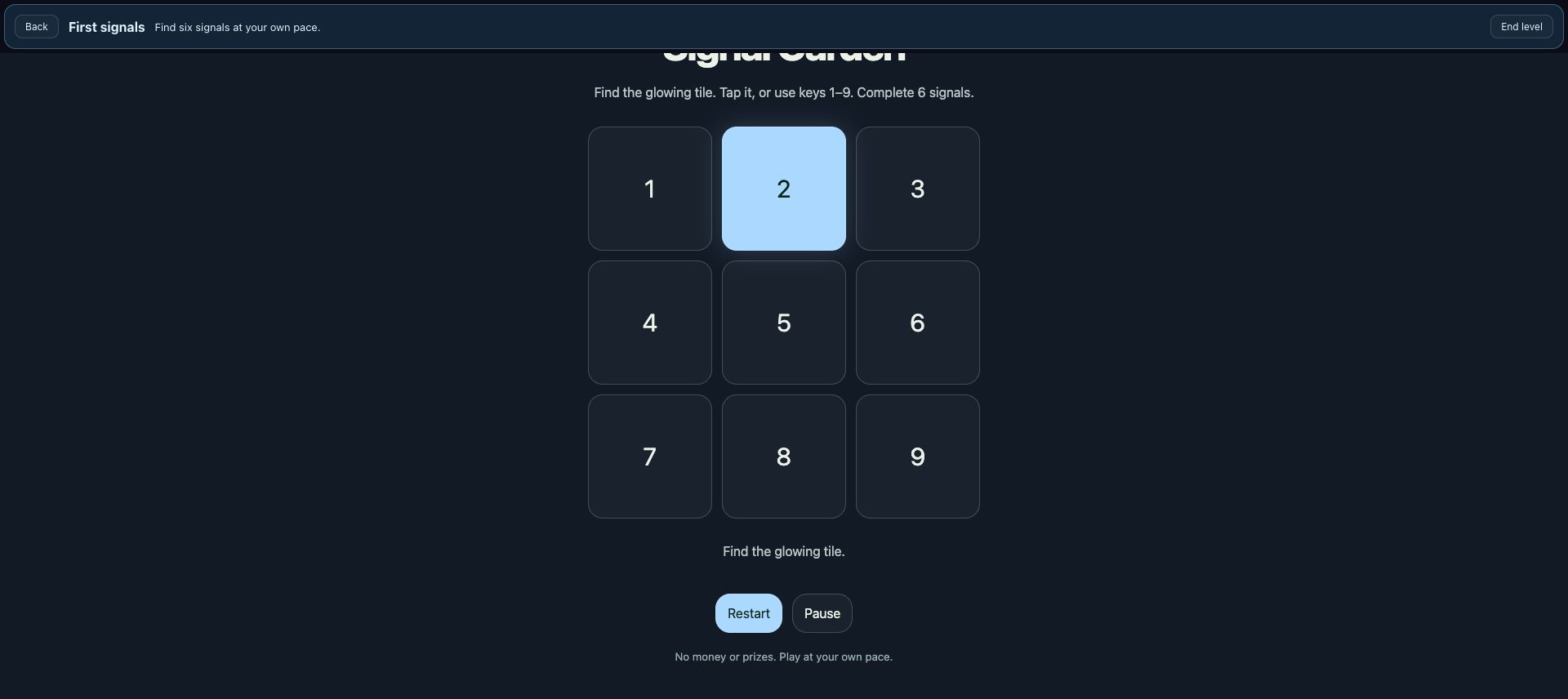
Write down the moment, not just a score.
Invite a willing adult tester, explain the access requirements, and let them try the opening before coaching. A short note can be enough:
- Context: game version, device, browser and input method.
- Action: what they clicked, tried again or skipped.
- Expectation: what they thought would happen.
- Outcome: what happened, and where they stopped.
Ask “What did you expect there?” after the attempt. Avoid putting your preferred explanation into the question. Keep account details and other personal information out of shared notes.
Treat a drop-off as a clue.
A completion count can tell you where to look. It cannot, by itself, tell you why someone left. Pair supported game metrics with the tester’s description.
| You observe | Check before changing |
|---|---|
| Repeated taps with no progress | Did they understand the target? Did the input register? Was the hit area usable? |
| A pause after the result | Could they explain the outcome and find the next action? |
| One completed round, no retry | Was retry visible? Did they want another round? Were they out of points or time? |
These are possible explanations, not diagnoses. One session can reveal a reproducible problem; it cannot establish retention or prove a version is better.
Make the next version answer the same question.
If the target was hard to see, try a clearer target state before changing the timer, score and layout together. Keep a copy of the original and check the new version privately.
A brief you can copy
Question: Can a new player identify the first target?
Observed: [exact action and expectation]
Context: [version, device, browser, input]
Proposed change: [one visual or control change]
Keep unchanged: [rules, timing and scoring]
Next check: [the same opening task]
Unknowns: [what this session did not tell us]
If you ask AI for a recommendation, include the observation and unknowns. Ask it to explain its hypothesis and propose one small change. Review and test its output before publishing; a confident explanation is not evidence.
Try the loop on Test.
Make a casino-style or skill game with AI, or bring a supported browser build. Explore player metrics, request recommendations and test private variations. The same account can play and create.
Start a prototype ↗Test is early. Metrics require compatible instrumentation and participating players; a testing audience is not included. AI output needs your review, and publication is subject to review.
18+ · Account required · Play uses a limited Testies allowance. Testies have no cash value. No cash wagers or prizes.